


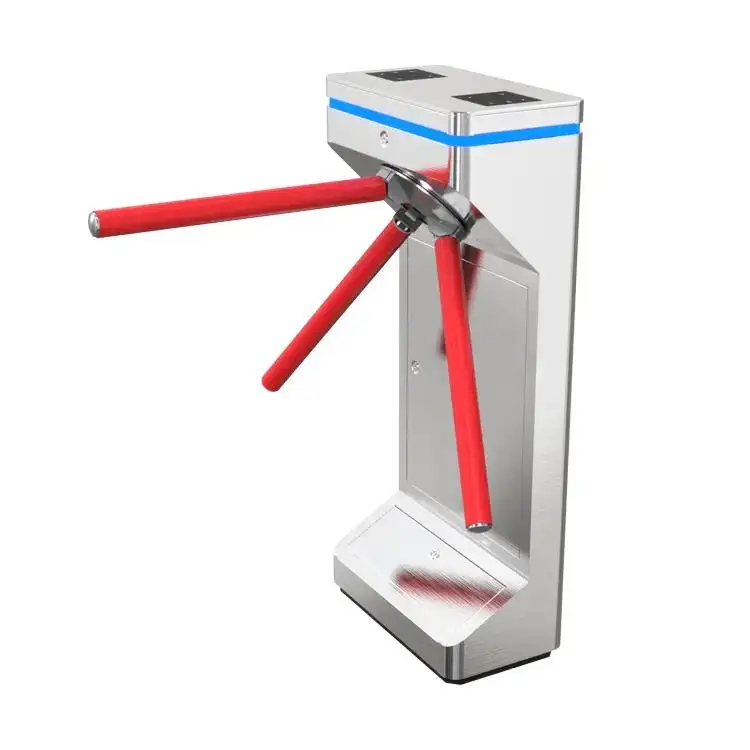
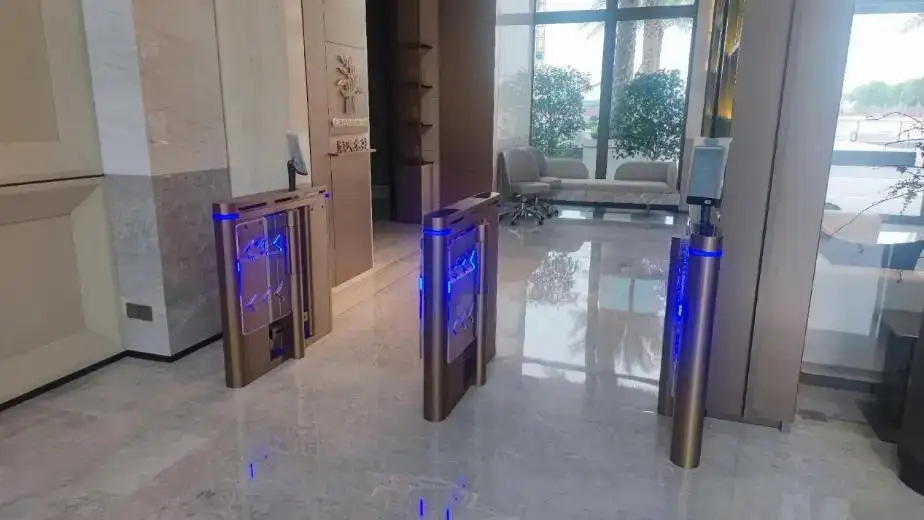
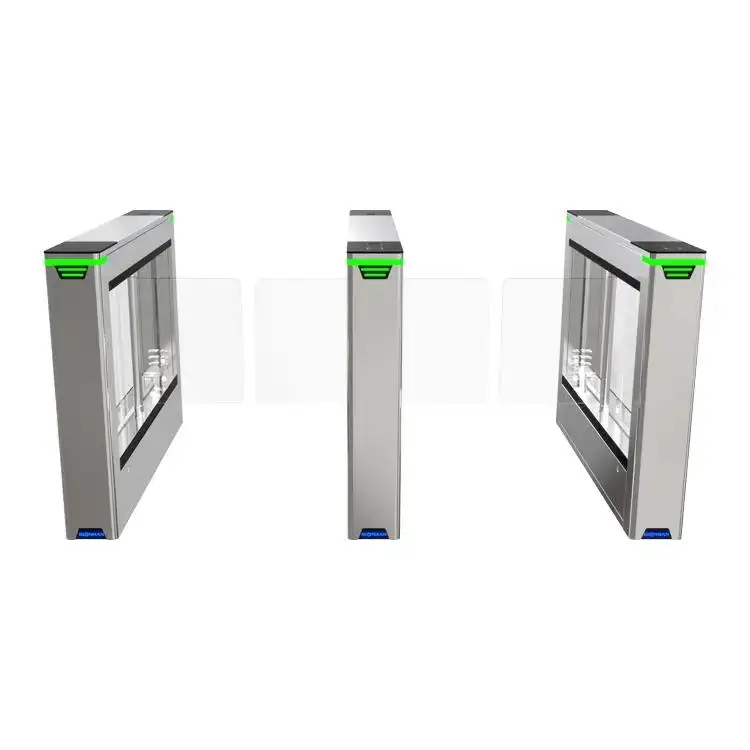
Access Control Swing Turnstile With Anti-Climb Design
2026-07-28


Access control swing turnstiles with anti-climb design is created for the entrance requiring a larger, more comfortable entry with little loss of physical security. Usually used in factories, schools, warehouses, homes, research centres, transport areas and controlled offices.
First, deal with the problem at hand.
This guide provides the buyers and system integrators with some information about what they should complete before they purchase, configure and test an Anti-climb swing turnstile.
Respond to the real security threat
Before installing a gate, ask them what the most common reasons are why the gate may be accessed by unauthorized individuals.
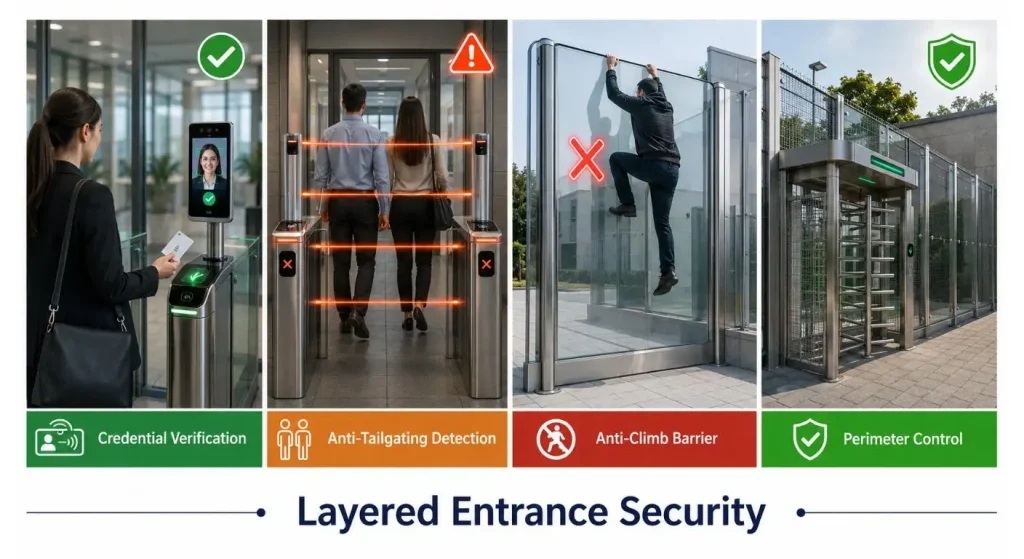
An invalid credential might be presented by one of them. A user can follow a user that has been approved. They could be able to get into the cabinet from another person's side, under the cabinet, over the cabinet or through the unfinished space next to the cabinet.
There are various controls for these actions. Access Software makes permission checks. Passage sensors are used for tracking the movement in the lane. Who can get on top of the stretched panel, walk around the walls and/or the railings or the fixed partitioning.
| Security Risk | Primary Control | Supporting Measure |
| Invalid credential | Access verification | Permission rules |
| Tailgating | Infrared sensors | Alarm response |
| Climbing | Extended barrier | Remove footholds |
| Side bypass | Fixed boundary | Close side gaps |
| Forced entry | Reinforced mechanism | CCTV or guard response |
An anti-climb swing gate should therefore not be the sole measure of security, but rather just another layer of security. While Ironman's anti-climb swing barrier gate is made of reinforced panels and can be motorized, access control can also be compatible, and it has passage detection, the final degree of protection will come down to the project layout and operating rules.
You will need to decide if a swing gate is a suitable gate at the entrance
If the entrance requires more space than a tripod or a narrow flap (turnstile) gate can accommodate, then there is a swing turnstile that can be used. It can be used by employees carrying equipment, for people needing a wider lane such as visitors with luggage, maintenance carts and more.
When using an anti-climb swing gate instead of a standard size gate that swings on its hinges from the top of the gateframe, it creates a greater barrier to jumping. In a canteen with a staffed entrance it's also usually less cumbersome than a full height turnstile and will blend more seamlessly into a contemporary setting.
The midway position stands this baby out, but what it lacks, it has in plenty as well. It should not be referred to as a “full height perimeter barrier. If the threat level is high or the entrance is not regularly monitored then a full height turnstile, fencing, guard response or cctv may still be required.
See the entire entry plan as well as the full set of product dimensions, not just choose an anti-climbing swing turnstile based on dimensions.
See outside the lines of the actual panel
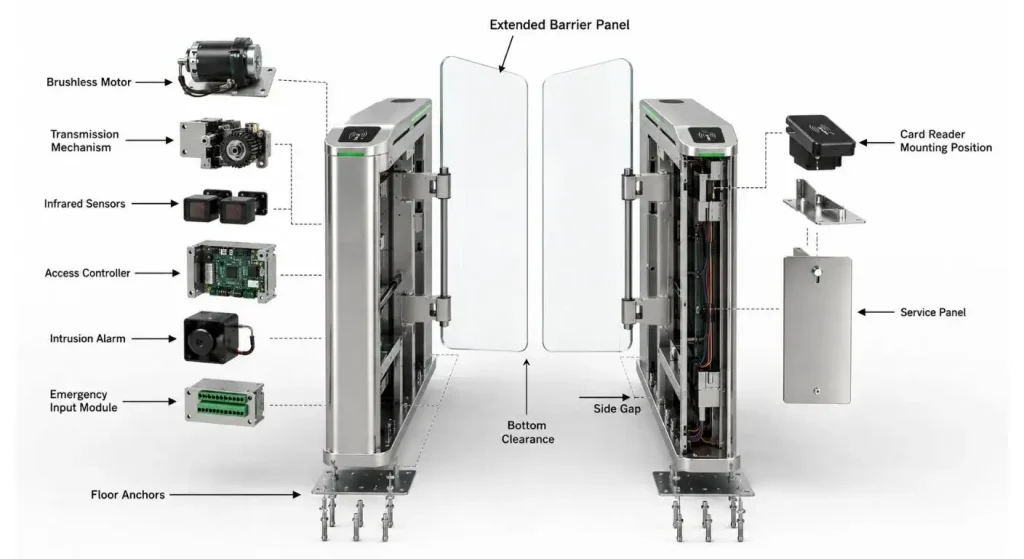
Removable convenient footholds and handholds will be eliminated in the good anti-climb design, and moving panel will remain stable. All the above – the kind of material used for the panels, edges treated, frame size, motor capacity, transmission configuration, cabinet rigidity, ground anchors, etc. should be reviewed by the manufacturer.
It isn't just about what's in the frames; it is just as essential what is not. Measure the distance below the panel, between the panel and cabinet, between lanes and between the last cabinet and the closest wall/rail. Correct – if someone can squeeze around the tall barrier or climb up onto some furniture nearby, you will lose the value of the tall barrier.
Please note that "Custom" changes require engineering review as well. A general increase in width of the lane or increase in height of glass panel places a greater load on the mechanism which can have an impact in the following areas: Opening speed, wind resistance, cabinet stability, and testing. The dimensions for the finalized object should be shown on an approved drawing, and should not be included in an email conversation.
Nearly all students are able to receive a qualification by sitting a test
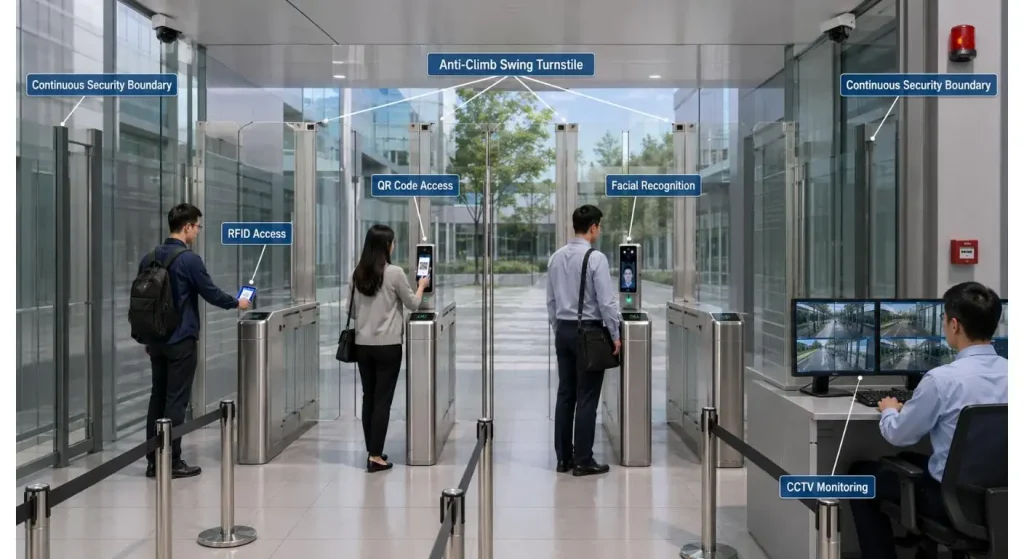
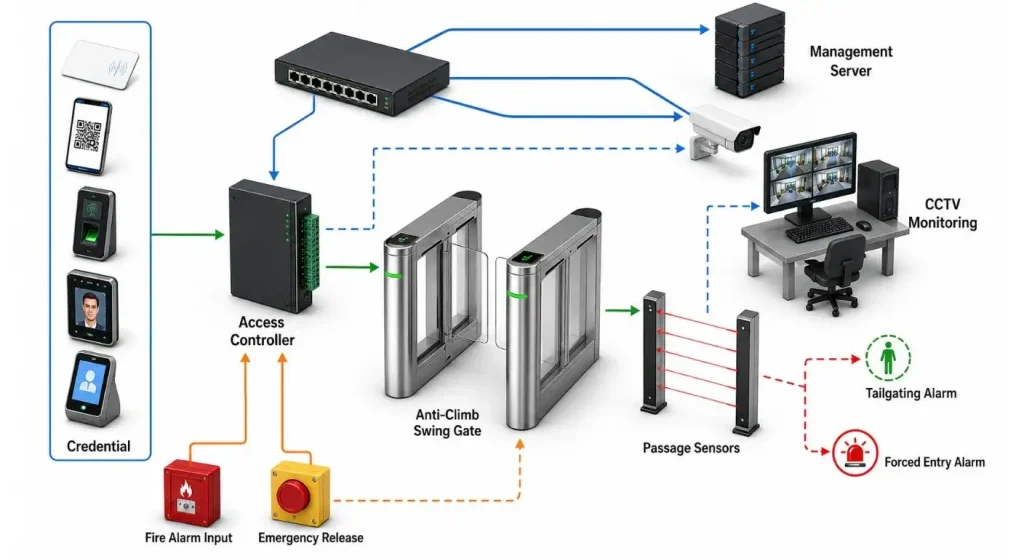
RFID card, mobile credential, QR codes, fingerprint terminal, facial recognition and 2-factor authentication can be used in a project. In both cases the reader, the controller and the gate logic need to be specified prior to the start of production.
Verify the reader model, mounting, signal for opening, communication interface, entry/exit directions, event records, and behaviours of the offline reader, and alarm outputs. But possible configurations are offered by Ironman’s access control equipment and resources for system-integration, but the approved reader, controller, software and gate should be tested together.
The term supports access control is to wide to make it a purchase order. The project team should have all the knowledge necessary for opening the gate, what to do if the communication breaks down and who risks what for each of the interfaces.
The two functions are separated from each other: Anti-climb and Anti-tailgating.
The higher the panel the more you will have to go over the barrier. It can't tell whether or not two individuals have signed into it after having signed into another site with a different authorization.
Anti-Tailgating relies of the following three factors: number and location of infrared sensors, passage algorithm, and detection response upon detection of abnormal passage. The lane may have to indicate close following, two-person crossing, going the wrong way or when someone runs into the gate without asking, someone stopping in the middle of the gate, and incomplete foot crossing.
Request a drawing of where the sensor will be placed, and obtain a detailed explanation of the operating steps. What is the time at which the panel starts its meeting? The user has a certain time interval to go by. How does it shut? Will an abnormal event sound an alarm, trigger a relay output, trigger a CCTV event or alert the security desk?
The above settings need to be the same as the users. It is incorrect to assume a slow opening for a school entrance, a factory gate or corporate make entry equal to a slow opening for another portion of the institution, such as a school opening or a corporate entry.
Identify and ensure a continual security boundary
Safety often doesn't happens at the turnstile – it happens around the turnstile.
Users should be prevented from walking around the last cabinet by having the gate be connected to walls, fixed glass, guard rails or fencing. It is common practice that people are directed towards readers and away from the barriers by queues and barriers, while avoiding the creation of steps for people to climb out of. Avoid placing benches/planters, storage boxes or temporary furniture on the expanded panel.
Position of the reader is important, too. Users should be able to log in and have access to the controlled area, as well as enough space to get out of the way if they are denied access by the next user.
Keep all three elements of Balance, Accessibility and Security in mind!
The wider the lane the more usable it is; the more significant this difference, the less it fits the physical design. The manufacturer may require their panels to be wider, motors to be more powerful, set the sensors to capture a wider area, set the opening time shorter and harder to close the cabinets, or have the cabinet anchored in a different location.
It doesn't mean that a swing gate can't be helpful in regards to passing through the gate for wide passage. It requires planning access to be incorporated into the full entrance as opposed to an access from one of the advertised entrance dimensions.
Installing outdoor protection takes multiple components
If any of the following is going to be true on an outdoor/common entrance or partially covered, consider direction of rain run-off, dust, humidity, drainage, sunlight, temperature, salt exposure and wind loading of the longer panel:
Ask about protection for all the cabinets, external reader, controller compartment, cable glands, motor area, fasteners and emergency controls. You can't just assume that having a weatherproof cabinet means that all the devices inside are secure.
The protection that is afforded by the electrical enclosures against objects and water can be classified from IEC 60529. If an IP rating is required, ensure that the enclosure tested matches the actual enclosure, if there are any openings, displays, cable openings or modifications, ensure that this does not affect the IP rating.
There needs to be a viable maintenance strategy for outdoor projects, too. This may result in a lower level of reliability as the time goes on because of obstructed drainage, a missing anchor, broken reader windows or frosted barrier panels.
Decide on the actions to be taken in case of emergency or failure
A safe entrance will continue to function safely in the absence of normal functioning.
The instructions of action for the power failure, network failure, controller failure, fume alarm, emergency-button, sensor failure, motor obstruction and manual security release should be determined in the project team.
Many answers are possible for each location. A few entrances require the panels to open by themselves. Some others might be unlocked for specific hand maneuvering needs or under the staff supervision.
The manufacturer needs to provide a description of the outputs and mechanical response of the signal. Final arrangement agreed to by architect, fire consultant, integrator, operator and local authority.
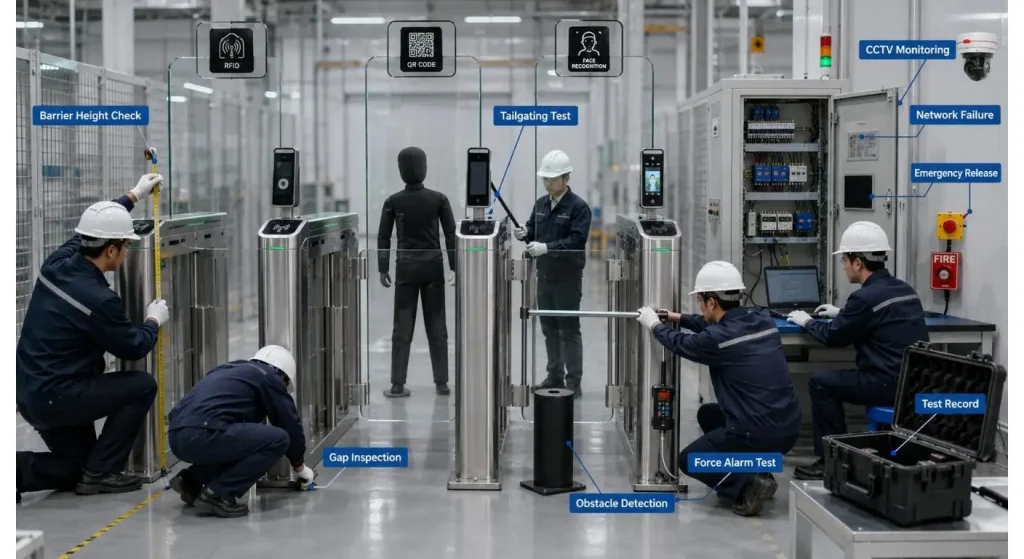
Ensure that the Approved Configuration is tested prior to shipment.
The test should include testing of credentials (both valid and invalid), one-person, tailgating, wrong direction, obstacles, incomplete passage, controlled pushing, alarm outputs, power recovery, alarm failure (Network), power up, emergency opening, remote release, and recording of the events.
Safe fixtures, measuring devices, soft test objects and controlled procedures should be utilized as the basis for anti-climb checks. The following should not be used as a demonstration:磅 employees are not to be asked to stand on either side of an operating gate.
Conclusion
Anti-climb design access control swing turnstiles can offer a valuable compromise between easy flow and enhanced physical security. It is the synergy between the panel, sensors, controller, boundary surrounding the panel, the foundation and their operating procedures, that make all the difference.
The words “anti-climb”—no matter how many are used—aren't ever of any particular value to a reliable manufacturer. It will be reviewed to improve the overall entrance, describe design restrictions, record all interfaces, try out the final configuration prior to delivery.
FAQs
Q1. What are the ways that access can be integrated?
The most common include RFID, QR code, mobile credentials, fingerprints and facial recognition. Compatibility should be tested prior to manufacture.
Q2. Will AntiClimb Design Make it Impossible to Make any Unauthorized Entry?
No. In addition to access verification, tailgating detection, CCTV and surrounding barriers and security response.
Q3. If Power/NW Failure, What Happens Then?
The gate performs in accordance with the approved fallback rule; for example, opening the gate, unlocking the gate or local verification. What is required to happen will differ based on the project.
Q4. Could Gate Trigger CCTV or Security Alarms be a reality?
Yes, if there are suitable outputs, or software interfaces. Alarms or CCTV events can be generated by tailgating, forced entry and invalid access.
Q5. Where to use Factory Testing?
Test credentials, tailgating, obstacles, forced pushing, network loss, emergency opening, event records. When possible, use final reader.
