


Access Gates for Government Facilities: Security and Compliance
2025-10-27


Government facilities—from federal buildings and military bases to local courthouses and research labs—represent a unique and critical category within building security. They house sensitive information, critical infrastructure, and personnel vital to public service and national security. Unlike a typical office building or commercial space, the stakes are exponentially higher. A breach is not just a matter of lost property; it can have significant public safety or national security implications.
Therefore, access control for government buildings requires a fundamentally different approach. It demands solutions that prioritize security and compliance above all else, often mandating technologies and protocols far exceeding commercial standards. The physical entry points are the first line of defense, and the government facility access gate is the cornerstone of that defense.
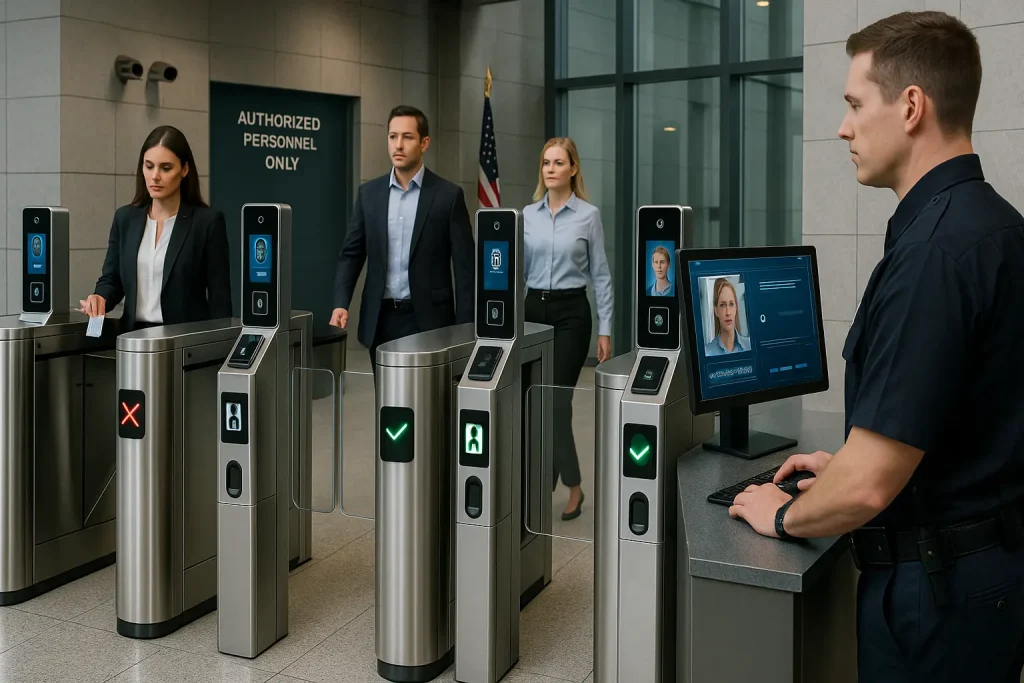
This is not simply a turnstile; it's a meticulously chosen, rigorously tested, and often heavily regulated piece of security infrastructure. It must meet stringent requirements for physical robustness, technological sophistication, and adherence to complex compliance mandates. This guide provides a definitive, expert look into the world of government facility access gates, exploring the unique challenges, critical requirements, available technologies, and best practices for implementation.
What Is a Government Facility Access Gate?
A government facility access gate is a high-security pedestrian or vehicle barrier specifically designed and implemented to meet the stringent security protocols and compliance regulations required for government buildings. These gates often incorporate robust physical construction, advanced credential verification (like PIV cards or biometrics), and integration with sophisticated monitoring systems.
Unlike the gates you might see at a typical office building pedestrian turnstile installation, which balances security with aesthetics and speed, a government facility access gate prioritizes security assurance and compliance adherence above all else. Speed and aesthetics are considerations, but they are secondary to the primary mission: ensuring only authorized individuals gain entry and that every access event is securely logged according to government standards. This often means employing different hardware and software configurations than those found in a standard commercial building entrance gate.
Why Are Access Gates for Government Facilities Different?
Gates for government facilities differ due to the significantly higher threat profile, the handling of classified or sensitive information, and the legal obligation to comply with specific federal security mandates (like FIPS 201/PIV, HSPD-12). These factors necessitate more robust physical barriers, advanced multi-factor authentication, and rigorous auditing capabilities.
The "character" of government security is defined by these unique pressures:
- Elevated Threat Profile: Government buildings can be targets for espionage, terrorism, or politically motivated attacks. The potential impact of a breach is far greater than in most commercial settings.
- Protection of Sensitive Information: Many facilities handle classified documents, sensitive personal data (e.g., social security, tax info), or critical infrastructure controls. Access must be strictly limited based on clearance levels and "need-to-know."
- Mandatory Compliance Frameworks: Unlike private companies, government agencies must adhere to specific, often complex, security standards dictated by law or executive order. Key examples include:
- HSPD-12 (Homeland Security Presidential Directive 12): Mandates secure and reliable forms of identification for federal employees and contractors.
- FIPS 201 (Federal Information Processing Standard 201): Defines the technical requirements for the Personal Identity Verification (PIV) card mandated by HSPD-12.
- FICAM (Federal Identity, Credential, and Access Management): Provides the architecture for implementing HSPD-12/FIPS 201 compliant access control.
- Requirement for High Assurance: The system must provide a very high degree of confidence that the person entering is who they claim to be and that they are authorized. This often necessitates multi-factor authentication.
These requirements shape every aspect of the access gate solution, from the physical steel to the cryptographic keys used in the credentials. This is fundamentally different from the primary goal of throughput seen in an airport speed gate system or a busy railway station pedestrian turnstile.
Key Security Requirements for Government Access Gates
Security requirements typically include robust physical construction (anti-tamper, forced entry resistance), advanced anti-tailgating/piggybacking detection, integration with multi-factor authentication (often using government-issued credentials like PIV cards), and fail-secure or specific emergency operation modes dictated by agency policy.
Designing a gate for a government facility demands a security-first mindset.
Robust Physical Construction
- Forced Entry Resistance: Gates must be built to withstand physical attack attempts. This involves heavy-gauge steel, reinforced barriers (thicker glass or solid metal arms), and secure anchoring.
- Anti-Tamper Design: Enclosures must be designed to prevent unauthorized access to internal electronics or wiring. Tamper switches that trigger alarms if panels are opened are standard.
- Environmental Durability: Gates, especially exterior ones, must withstand harsh weather conditions, temperature extremes, and potential vandalism.
Advanced Anti-Tailgating/Piggybacking Detection
This is absolutely critical. Government facilities cannot tolerate unauthorized individuals slipping through behind authorized personnel.
- High-Density Sensors: Gates must employ sophisticated sensor arrays (often 30-60+ beams or advanced imaging) capable of accurately detecting if more than one person attempts to pass per authorization.
- Directional Logic: The system must prevent "wrong-way" entry attempts through exit lanes.
- Specialized Detection: Logic to detect crawl-under or jump-over attempts is often required, potentially using pressure sensors or overhead monitoring.
Multi-Factor Authentication (MFA) Integration
Single-factor authentication (like just a card) is often insufficient. Government mandates typically require MFA, especially for accessing more sensitive areas. The gate must integrate readers capable of supporting:
- Something You Have + Something You Know: e.g., PIV Card + PIN Code entered on a keypad.
- Something You Have + Something You Are: e.g., PIV Card + Biometric (Fingerprint/Facial/Iris) verification.
- PIV/CAC Card Compatibility: Readers must be FIPS 201 compliant and capable of reading the cryptographic certificates on government-issued PIV (Personal Identity Verification) cards for federal employees or CAC (Common Access Card) for military personnel.
Secure Operation Modes
- Fail-Secure vs. Fail-Safe: Unlike commercial buildings where fire codes often mandate "fail-safe" (gates unlock on power loss), high-security government areas may require "fail-secure" (gates remain locked) to prevent breaches during a power outage, provided that safe egress routes are still available and meet code. This is a critical design decision based on specific agency policy and life safety analysis.
- Emergency Lockdown: The system must integrate with emergency lockdown protocols, allowing security personnel to instantly lock down specific gates or the entire facility in response to a threat.
Compliance Considerations: Meeting Federal Mandates
Compliance is non-negotiable. Systems must adhere to standards like FIPS 201 for credentialing and reader specifications, FICAM architecture for integration, and often NIST (National Institute of Standards and Technology) guidelines for cybersecurity and risk management, ensuring interoperability and high security assurance.
Navigating these acronyms is essential for anyone involved in government security.
FIPS 201 and the PIV Card
- What it is: The standard defining the government's PIV card. It specifies the card's physical and electronic characteristics, including the cryptographic keys and biometric data stored on its chip.
- Gate Requirement: Your
government facility access gatereaders must be FIPS 201 certified and listed on the GSA Approved Products List (APL). They need to perform the required cryptographic checks to validate the PIV card is authentic and has not been tampered with. Simple "card number" readers are not compliant.
FICAM (Federal Identity, Credential, and Access Management)
- What it is: An overarching architecture or roadmap designed to ensure government-wide interoperability for identity management and access control using HSPD-12/PIV credentials.
- Gate Requirement: Your entire access control system, including the gates, panels, and software ("the brain"), should ideally align with the FICAM architecture to ensure it can integrate properly with government identity systems and meet future requirements.
NIST Standards (Cybersecurity & Risk)
- What they are: NIST provides extensive guidelines on cybersecurity best practices, risk management (like the Risk Management Framework - RMF), and secure system configurations.
- Gate Requirement: While not always directly certifying the gate hardware, the networked components of your access control system (panels, servers, cloud connections if applicable) must adhere to relevant NIST cybersecurity guidelines (e.g., NIST SP 800-53) to protect against hacking and data breaches. This is critical as the gate is an endpoint on the network.
My Experience: "Achieving and maintaining compliance is a continuous process. Simply buying a 'FIPS 201 reader' is not enough. The entire system architecture, installation, and operational procedures must meet these stringent standards. Working with integrators who specialize in federal compliance is crucial."
Types of Access Gates Suitable for Government Facilities
The choice depends heavily on the specific location's security level (perimeter, lobby, internal high-security zone). Common options include full-height turnstiles for robust perimeter control, security revolving doors or mantrap portals for absolute single-person passage, and optical speed gates (often with taller barriers) for lobbies balancing security and throughput.
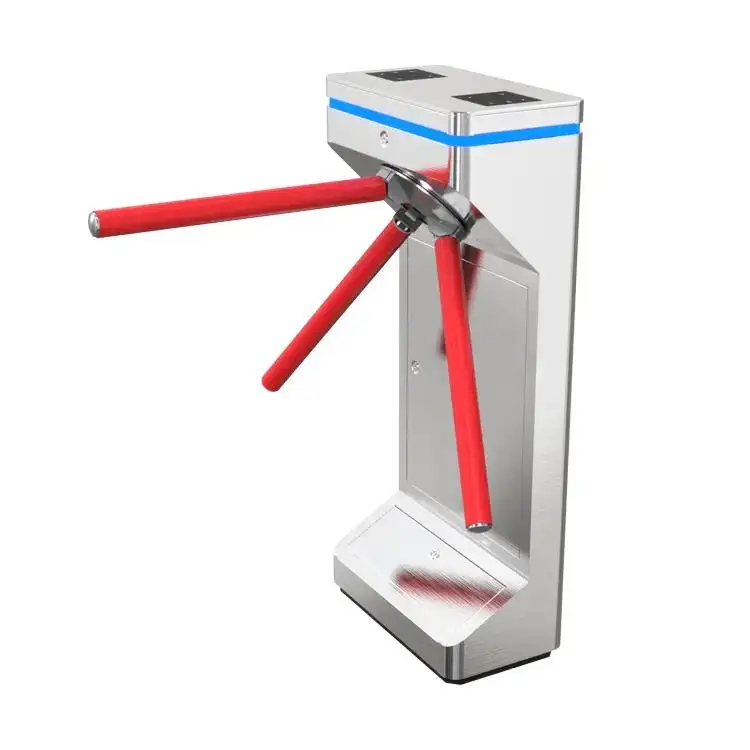
1. Full-Height Turnstiles (The Perimeter Workhorse)
- Description: Floor-to-ceiling, typically rotating metal arms in a "cage-like" structure. Provide a highly visible, robust physical barrier.
- Pros: Highest physical security against climbing/crawling, relatively cost-effective for perimeter control, highly durable.
- Cons: Low throughput (slow passage), industrial aesthetic, can feel "confining" to users.
- Best For: Outdoor perimeter access points, fence lines, entry to non-public areas like utility zones.
2. Security Revolving Doors & Mantrap Portals (The Single-Entry Enforcers)
- Description:
- Security Revolver: A revolving door with compartments designed to allow only one person per rotation, often using sensors or weight mats inside.
- Mantrap Portal: A small vestibule with two interlocking doors. The first door must close and lock before the second door will open, ensuring only one person enters at a time. Often uses biometrics or weight sensors inside.
- Pros: The highest possible assurance of single-person passage; virtually eliminates tailgating and piggybacking.
- Cons: Very low throughput (slowest option), highest cost, can be claustrophobic.
- Best For: Access points to extremely sensitive areas (SCIFs, data centers, labs, vault entrances) where absolute certainty of single entry is paramount.
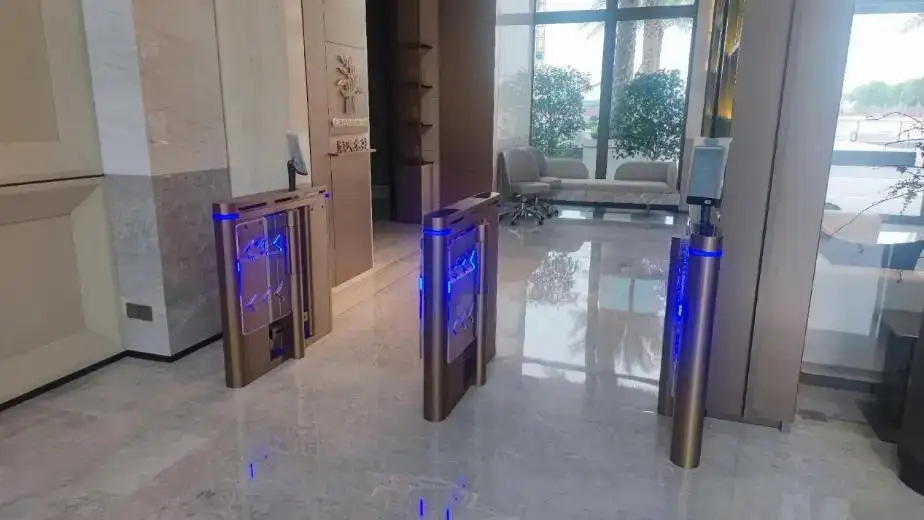
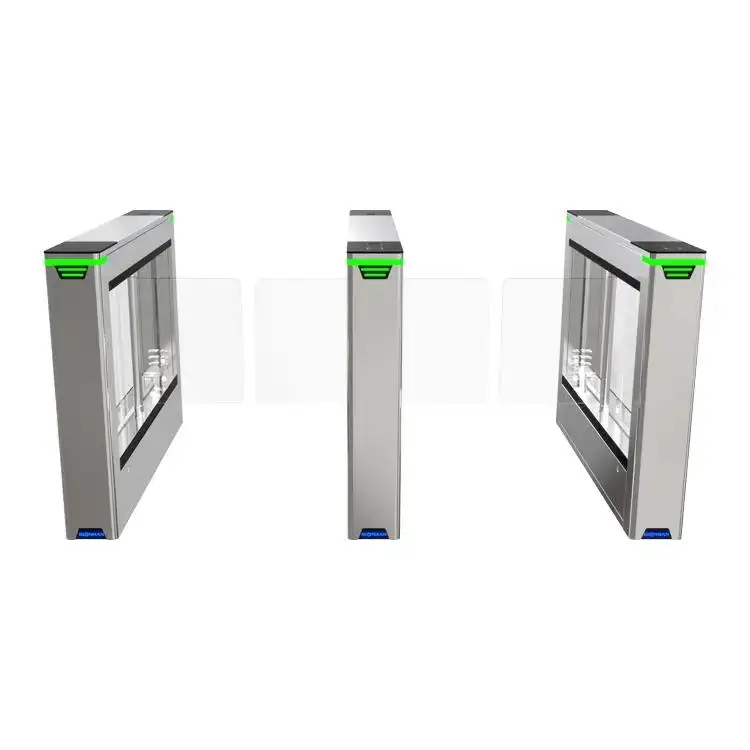
3. High-Security Speed Gates (The Controlled Flow Option)
- Description: Motorized gates, often similar to those in corporate lobbies, but built to higher security specifications. This typically includes:
- Taller Barriers: Glass or metal barriers that are harder to jump over (e.g., 1.2m to 1.8m high).
- More Robust Construction: Heavier gauge steel, reinforced components.
- Advanced Sensors: The most sophisticated anti-tailgating sensor packages available, often with AI-driven logic.
- Types:
- Sliding Gates: Tall panels slide open like elevator doors. Offer excellent security but are slower.
- Swing Gates: Tall arms pivot open. Offer a good balance of security and speed.
- Pros: Balances higher security with reasonable throughput (faster than portals/revolvers), more aesthetically pleasing for main entrances than full-height turnstiles.
- Cons: Higher cost than standard speed gates, still potentially vulnerable to highly determined intrusion attempts compared to portals.
- Best For: Main building lobbies, secondary internal checkpoints, areas requiring a balance between strong security and processing moderate traffic volumes.
The choice of gate must align with the specific security requirements of the zone it protects within the overall access control for buildings strategy.
Credential Technologies for Government Access
Government facilities primarily rely on FIPS 201 compliant PIV/CAC cards, often requiring multi-factor authentication (Card + PIN or Card + Biometric). Biometrics (fingerprint, facial, iris) are increasingly used as either a primary or secondary factor for high-assurance identity verification.
- PIV / CAC Cards (The Foundation): As mandated by HSPD-12, these encrypted smart cards are the baseline for federal employee and contractor access. The
government facility access gatemust be able to read and validate these cards cryptographically. - PIN Codes (The Second Factor): Often required in conjunction with a PIV/CAC card, especially for higher security areas. The user inserts/taps their card and then enters a PIN on an adjacent keypad.
- Biometrics (The High-Assurance Factor):
- Fingerprint: Widely used, mature technology. Often integrated directly onto readers.
- Facial Recognition: Increasingly popular for its speed and "frictionless" nature, though privacy policies must be carefully managed.
- Iris Recognition: Offers the highest accuracy but is slower and more expensive. Typically reserved for the most sensitive locations. Biometrics provide the strongest identity assurance because they verify "who you are," not just "what you have."
Mobile credentials, while popular in commercial spaces, face slower adoption in government due to stringent security requirements and the established PIV infrastructure, though pilot programs exist.
Integration with Other Security Systems
A government facility access gate rarely operates in isolation. It must integrate seamlessly with the facility's broader security ecosystem, including the central access control software, video surveillance (VMS), intrusion detection systems (IDS), and potentially visitor management and emergency notification systems.
- Access Control Software (The "Brain"): This is the core integration. The gate sends credential data and status updates to the central software, which makes the ultimate authorization decision and logs all events.
- Video Surveillance (VMS): Alarms from the gate (e.g., "tailgating attempt," "forced open") should automatically trigger nearby cameras to record and bookmark the event, providing immediate visual verification for security personnel.
- Intrusion Detection Systems (IDS): Forcing a gate open or tampering with it should trigger an intrusion alarm within the facility's main security panel.
- Visitor Management Systems (VMS): For facilities receiving visitors, the access gates must integrate with the VMS to allow temporary, controlled access (often using QR codes or temporary badges) after proper vetting.
- Emergency Systems: Integration with fire alarms (for safe egress) and mass notification systems (for lockdowns) is critical for life safety and incident response.
This deep integration requires adherence to open standards (like OSDP for reader-panel communication) and often involves complex configuration by specialized integrators familiar with government requirements.
Installation, Maintenance, and Lifecycle Management
Installation must be performed by cleared personnel following strict protocols. Maintenance requires regular testing and calibration, especially for sensors and locking mechanisms. Given the long budget cycles in government, lifecycle planning for upgrades and replacements is crucial.
- Cleared Installers: Depending on the facility's security level, installation technicians may require background checks or security clearances.
- Rigorous Testing: Post-installation testing must be thorough, verifying not just basic operation but all security features (anti-tailgating sensitivity, tamper alarms, MFA integration, fail-secure/fail-safe modes).
- Preventive Maintenance: Regular, scheduled maintenance is critical for these high-security devices. This includes sensor cleaning/calibration, motor checks, and software/firmware updates. Neglecting maintenance can lead to vulnerabilities or failures.
- Lifecycle Planning: Government procurement cycles can be long. It's essential to plan for technology refreshes years in advance to avoid being stuck with obsolete, unsupported, or vulnerable hardware. Choose vendors with a clear product roadmap and long-term support commitments.
The Future: AI, Predictive Security, and Identity Hubs
The future of government access gates involves greater intelligence through AI-driven analytics, more sophisticated "sensor fusion" for enhanced detection, and integration into broader "identity hubs" that manage both physical and logical (cyber) access based on real-time risk assessments.
- AI-Powered Sensor Fusion: Gates will combine data from IR sensors, video, and potentially audio or radar to build an incredibly accurate picture of who or what is attempting passage, virtually eliminating false alarms and detecting novel intrusion methods.
- Predictive Analytics: The system won't just react to alarms; it will predict risks. AI analyzing access patterns might flag an employee attempting unusual access as a potential insider threat before they cause harm.
- The Identity Hub: Physical access (the gate) and logical access (logging into a computer) will merge. Your single, verified identity (potentially using continuous multi-factor authentication) will grant you appropriate access to both physical spaces and digital resources based on your role, location, and real-time risk factors.
- Quantum-Resistant Cryptography: As quantum computing evolves, the cryptography used in credentials (like PIV cards) and communication protocols will need to be upgraded to quantum-resistant algorithms to maintain security assurance.
The Final Verdict: The Uncompromising Guardian
The government facility access gate is more than just a door controller; it is an uncompromising guardian at the perimeter of national security and public trust. Driven by stringent compliance mandates and the need for high assurance, these systems employ robust physical designs, sophisticated sensor technology, and advanced credential verification methods.
Choosing, implementing, and maintaining these gates requires specialized expertise and a deep understanding of the unique security landscape of government operations. While the technology will continue to evolve towards greater intelligence and integration, the core mission remains unchanged: to provide an unwavering, verifiable layer of protection for the critical assets and personnel within. It's a specialized field where the demands significantly differ from those for an office building pedestrian turnstile or a typical commercial building entrance gate, requiring a dedicated focus on security and compliance above all else.
